How red light therapy actually works.
No mysticism, no miracle language. Light of particular wavelengths is absorbed by particular structures inside your cells, and that absorption changes how those cells make energy. Here is the mechanism, the numbers behind our machine, and — the part most pages skip — where the evidence runs out.
- Written for patients, not marketers
- Real device specifications
- Includes the limits
The short version
Certain cells in your body contain molecules that absorb red and near-infrared light particularly well. When they do, a chain of ordinary biochemistry follows: the cell's energy-producing machinery works a little more efficiently for a while. That is the whole idea. Everything else on this page is detail about which light, how deep, and how much.
The formal name is photobiomodulation — literally, using light to modulate biology. It is not heat therapy, it is not tanning, and there is no ultraviolet involved. You feel warmth and brightness; the work happens at a scale you cannot feel.
What happens between the light leaving the LED and anything changing in you
Light reaches tissue
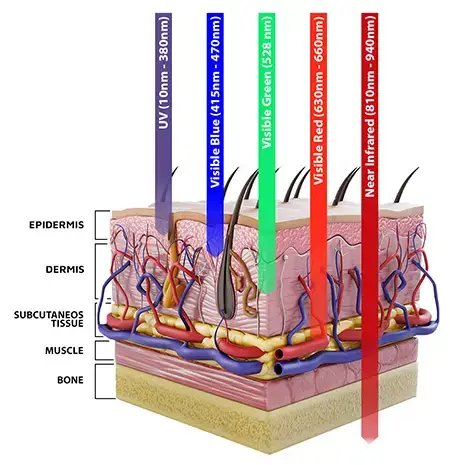
Photons enter the skin. How far they travel depends on their wavelength — this is the single most important variable in the whole field, and the reason a device's wavelength list matters more than its brightness.
A chromophore absorbs them
A chromophore is simply a molecule that absorbs light at a particular wavelength. Photobiomodulation depends on hitting the right ones. The Elysium is built around three of them — described in detail below.
Mitochondria respond
The best-studied target is cytochrome c oxidase, an enzyme in the mitochondria — the structures that produce most of your cells' energy. Absorption there is associated with more efficient energy production and signalling changes within the cell.
The effect is local, then general
Changes begin in the tissue the light reached. Because the light covers your whole body in a bed rather than one patch, the exposure is systemic rather than a single treated spot. This is where honest description stops and speculation would begin — so we stop here.
Different wavelengths are absorbed by different things
This is why "red light" as a single category is misleading. The Elysium's six wavelengths are chosen to reach three distinct absorbers, at three different depths.
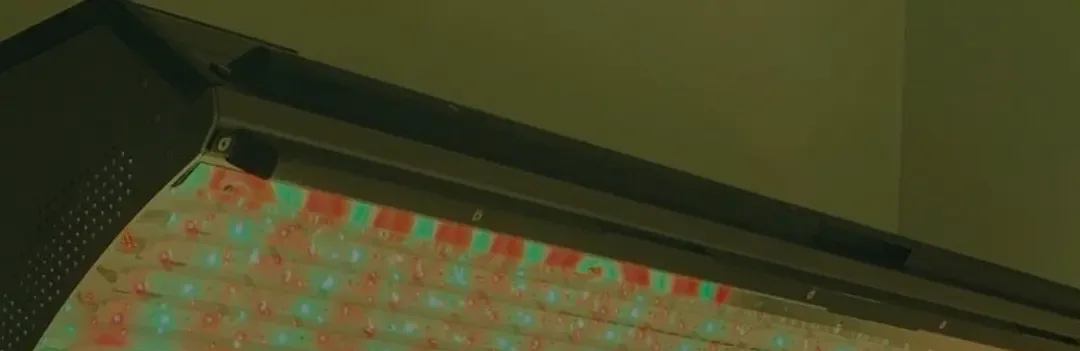
Six emitters, three absorbers, one session
Cytochrome c oxidase
An enzyme inside the mitochondria. Absorbs visible red and the shorter near-infrared bands. This is the pathway most photobiomodulation research is built on.
Water in cell membranes
Longer near-infrared, at 940 nm, is absorbed by water rather than by an enzyme — a different mechanism reaching different structures.
Blood
Green light at 530 nm is absorbed strongly in blood. It is the shallowest of the three and the one least often included on consumer devices.
The six wavelengths, and what each one is for
A clinic that will not tell you its wavelengths is asking you to trust a machine it will not describe. Ours, as published by the manufacturer:
| Wavelength | Band | Primary absorber | Relative depth |
|---|---|---|---|
| 530 nm | Visible green | Blood | Shallowest |
| 633 nm | Visible red | Cytochrome c oxidase | Skin depth |
| 660 nm | Deep red | Cytochrome c oxidase | Skin depth |
| 810 nm | Near-infrared (invisible) | Cytochrome c oxidase | Deeper tissue |
| 850 nm | Near-infrared (invisible) | Cytochrome c oxidase | Deeper tissue |
| 940 nm | Near-infrared (invisible) | Water in cell membranes | Deepest |
Two of those six you can see. Four of them you cannot — near-infrared is invisible to the human eye, which is worth knowing before you judge any light therapy device by how dramatic it looks. Brightness is not dose.
Why the same light does different jobs
Shorter wavelengths are absorbed near the surface; longer ones travel further before they are absorbed. That is why a device offering one wavelength is, by definition, working at one depth. Skin and deeper tissue are not the same target and do not respond to the same light.
Combining bands across the visible-red and near-infrared range is how a session reaches more than one layer of you at once — and it is the clearest technical argument for a multi-wavelength device over a single-colour panel.
More is not better. This is the single most misunderstood fact in red light therapy.
Photobiomodulation is dose-dependent, and the dose response is not a straight line. Too little light does nothing measurable. The right amount is associated with the effects people are seeking. Past that, the benefit does not keep climbing — it falls away again.
This has an obvious commercial consequence, which is why you rarely read it on a page trying to sell you sessions: buying more time in the bed is not the same as buying more benefit. A clinic incentivised to sell you the largest possible package has a reason not to mention the shape of that curve.
It is also why we assess before we recommend, why sessions are a defined length rather than "as long as you like", and why a typical protocol is a couple of sessions a week rather than daily. If someone offers you unlimited sessions as though volume were the product, they are selling access, not dosing.
Your cadence is set after your scan and reviewed by Dr. Iso's team. If a lighter schedule is the right answer for you, that is what we will tell you — it is also the cheaper answer, which is rather the point. Pricing is posted in full.
The other technologies in the bed — described honestly
The Elysium layers several technologies alongside photobiomodulation. They do not all rest on the same depth of evidence, and we would rather say so than let the list do persuasive work it hasn't earned.
Pulsed light delivery
Rather than a constant beam, output can be pulsed — the Elysium's channels are rated to very high pulse rates. Pulsing is a long-standing variable in photobiomodulation research and part of why a protocol library exists at all.
PEMF
Pulsed electromagnetic fields, delivered underneath the light rather than sold as a separate appointment. PEMF has its own literature and its own devices; here it is one layer of a combined session.
TENS microcurrent
Low-intensity electrical stimulation of the kind widely used in physiotherapy. In this bed it runs at a level most people barely register.
Scalar field
Included in the flagship configuration. We will say plainly that this is the least-studied element in the stack and we do not build our case on it. It is part of the platform, not a promise. Ask us about it and you will get this same answer in person.
The scan and the library
An AI-guided bioenergetic scan proposes a session from a library of 1,800+ protocols. A proposal is not a prescription: your protocol is reviewed by Dr. Iso's team before it runs.
What this is good for — and what it isn't
Photobiomodulation has been studied for decades and the body of research is large. It is also uneven: many studies are small, and protocols vary so widely between them that comparing results is genuinely difficult. Anyone quoting you a single dramatic percentage is quoting one study, not a consensus.
The areas with the most consistent signal — and the only ones we position this service around — are recovery, circulation, skin health and cellular energy. That is a deliberately short list. It is short because it is the part we are willing to defend.
Red light therapy is not a treatment or cure for any disease, and it is not a weight-loss procedure. If you have a specific medical condition, the right first step is a conversation with a physician about that condition — which, conveniently, is something this clinic can actually do.
Come see the actual machine.
What you see is what you'll lie in.
Where to go from here
The machine itself
Full specifications, the session step by step, and the safety screening we run before anyone lies down.
Before you buy anywhere
The five questions we would ask any clinic — including this one — before paying for a package.
Straight answers
Is it legit? Will it help me lose weight? Who shouldn't do it? Answered in a physician's voice.
Read the science. Then come see it.
The Elysium Experience includes an assessment, the scan, and a full session — so you can judge the machine in person rather than from a web page.